
Described in 1876 as ‘a region of villas and nursery gardens, very pleasant’ (James Thorne, Handbook to the Environs of London), Tooting has ancient origins.
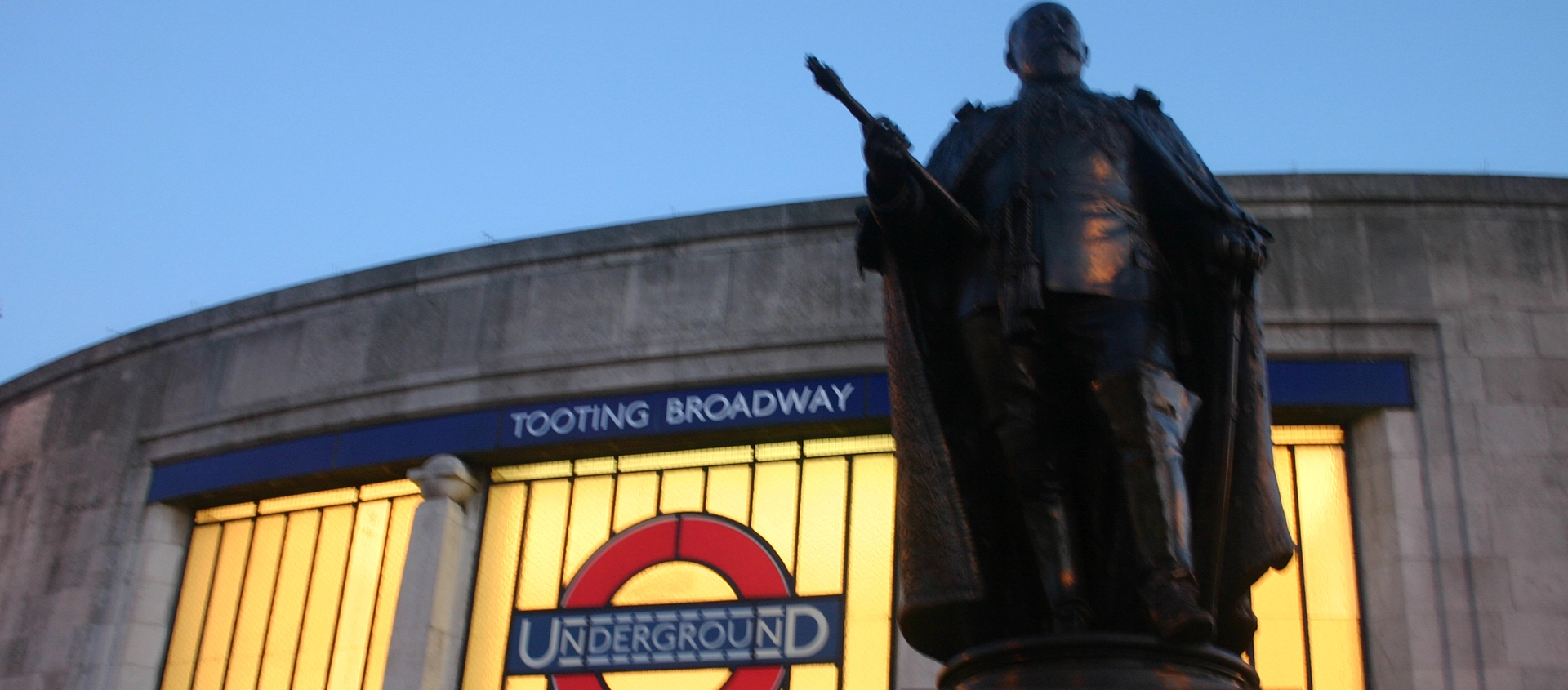
Tooting Broadway Station Photo © Photographer Sue Cutler
The long straight high road follows the line of the Roman Stane Street and remnants of a mosaic floor, possibly from a Roman villa, were found nearby. The name is thought to have Saxon origins, meaning ‘the dwelling of the sons of Totas’. It appears in the Domesday Book of 1086 as ‘Totinges’. By then it consisted of two distinct areas: Tooting Bec (Upper Tooting) and Tooting Graveney (Lower Tooting). The manor of Upper Tooting was assigned to the Benedictine monks of the Abbey of Bec in Normandy (hence Tooting Bec) while the manor of Lower Tooting, belonging to Chertsey Abbey, became the property of the De Gravenell family (hence Tooting Graveney).
Elizabeth I visited Tooting in 1600 and some of the oak trees on Dr Johnson Avenue are said to have been planted in her honour. Samuel Johnson himself was a frequent visitor to the Thrale family home at Streatham Park in Upper Tooting. A Dissenters’ chapel on Tooting High Street is reputed to have been founded in 1688 by Daniel Defoe, a leading Dissident and author of Robinson Crusoe; this has never been verified but the chapel bears his name.
Tooting remained a small Surrey village until the 1880s when its transformation into a London suburb began. In 1900, it became part of the London Borough of Wandsworth. During the next 20 years, many fine villas (Park Hill, Lynwood House and Elmwood House among them) were demolished to make way for streets of terraced housing. Between 1901-11, the London County Council built a pioneering new cottage estate for working-men and their families: the Totterdown Fields Estate, now a conservation area. In 1926, Tooting’s transport links were improved by the opening of two underground stations on the extended Northern Line (then the City & South London Railway).
Buildings in Tooting today are St George’s Hospital (part of the University of London), the former Granada Cinema on Mitcham Road (the first cinema to receive a Grade 1 listing) and Tooting Bec Lido, the biggest freshwater lido in the UK.
